M&A-value loop for owners backup
M&A VALUE LOOP
[nz_separator color_from=“#5c63e8″ color_to=“#4ea4fd“ top=“0″ width=“200″ height=“3″ align=“center“][nz_gap height=“15″]With the M&A-Loop, match.IT has developed it’s own proceed model.
It represents the successful realization for owners and investors in the IT market
of corporate transactions in the three main phases:
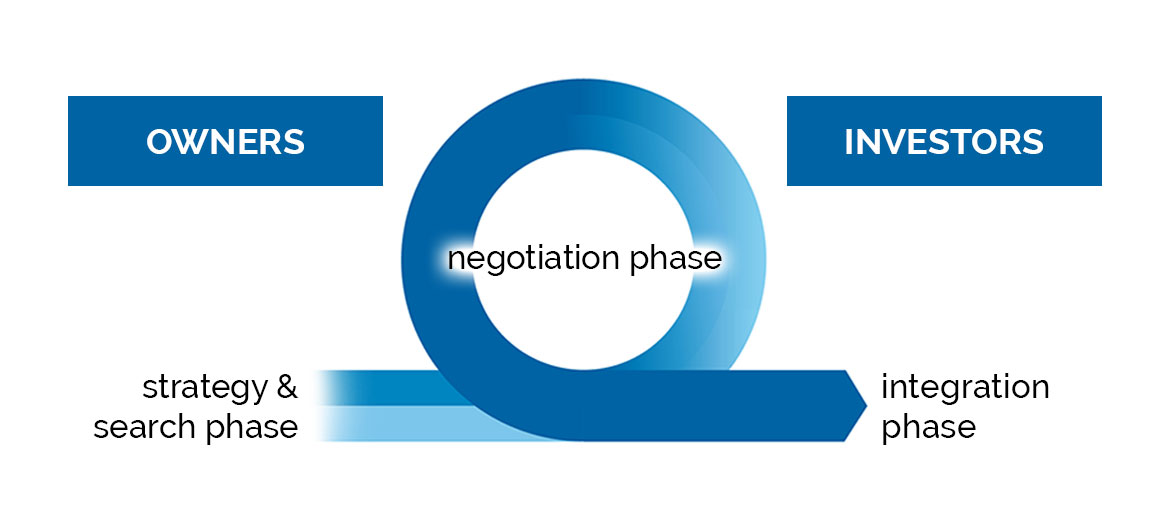
The M&A-Loop is our guideline for the preparation and execution of M&A-transactions in the IT-sector.
The goal: ensure the quality of the project results.
the following interactive process model shows each step of an M&A-transaction from the perspective of an owner.
[matchloopowner]
M&A-LOOP FROM THE PERSPECTIVE OF AN OWNER
[nz_separator color_from=“#5c63e8″ color_to=“#4ea4fd“ top=“0″ width=“200″ height=“3″ align=“center“][nz_gap height=“70″]STRATEGY AND SEARCH PHASE
[nz_separator color_from=“#5c63e8″ color_to=“#4ea4fd“ top=“0″ width=“200″ height=“3″ align=“center“][nz_gap height=“20″]In this phase before a concrete transaction we define the strategic goals together with you and prepare them. This includes an initial analysis and evaluation of the starting situation in your company as well as the derivation of an M & A strategy. With it we determine the desired form of the transaction, the time horizon and other relevant decision parameters. And another important part of the preparation phase: We compose your company documentation in short (teaser) and long form (Exposé). Based on a market analysis, we then identify potential buyers (in a long list) and contact them to explore a potential buying interest. This is how we determine the relevant prospective buyers for concrete negotiations step by step. As a rule, the resulting shortlist comprises 3-5 companies with whom further discussions are now underway. The quality of this selection process, the so-called matching, is the unconditional foundation for the success of all further transaction steps.
THE STRATEGY AND SEARCH PHASE INCLUDES THE FOLLOWING ACTIVITIES
[nz_gap]M&A-Readiness-Check
With the M&A-Readiness-Check we raise the exact status of your company in advance of a transaction.So we identify possible „show-stopper“, but also the actions that are important and successful for a successful sale.
M&A-strategy
In the M&A-strategy we determine the desired form of transaction with you.
Should the entire company be sold or only shares?
At what time horizon should a sale be made?
Are you ready to stay in the company for a transitional period?
What would be the ideal buyer in your opinion?
Market-research
On the basis of the search profile for the ideal investor, defined in the context of the M&A-strategy, a market research is carried out in order to develop a first selection of possible concrete investors.It can be accessed on a variety of current databases and ongoing studies as well as on its own M & A database and the extensive network of match.IT.
Teaser / Exposé
The teaser is a anonymous short description of your company to be sold.
He should bring the essential characteristics of your company to the point and with a positive representation of your story the interest of a possible investor awaken.
If an investor is interested in receiving further information after receiving the teaser, he will receive a detailed exposé after signing a confidentiality agreement. This exposé includes a – in comparison to the teaser – detailed company description. It contains corresponding business figures from the past and – as a look into the future – the business plan.
Investor-requests
Once we have described the ideal buyer, we will contact potential buyers who fit into the grid and provide them with the teaser. To ensure anonymity, we as an external service provider send this teaser. In doing so, we also answered the first questions of possible interested parties and check for pending answers.
Matching
Based on the market research, a long list is first agreed with the customer. This takes into account both the proposals from the market research and the special conditions (for example, blocked list with competing companies) of the customer and then includes the investors to be addressed in the first step. From the long list goes – in the course of further information about potential investors – the smaller short list. Possible criteria for the buyer rating include: strategic fit, size and financial stability as well as previous experiences and activities in the M&A-environment.
NEGOTIATION PHASE
[nz_separator color_from=“#5c63e8″ color_to=“#4ea4fd“ top=“0″ width=“200″ height=“3″ align=“center“][nz_gap height=“20″]The negotiation phase includes the execution of the negotiation process – from the first confidentiality declaration to the signature of the sales contract. In this phase, there may well be parallel negotiations with several prospective buyers – also organized in the form of an auction. The negotiation phase is a highly structured process which, in addition to many formal-legal aspects, also contains numerous negotiating-tactical elements. Here it is essential for the success of the entire transaction that the decision makers on the seller and the buyer side also find each other on a personal level. If successful, then the signing and the entry into force of the purchase contract (Signing and Closing) will be at the end.
THE NEGOTIATION PHASE INCLUDES THE FOLLOWING MODULES:
[nz_gap]Confidentiality agreement
If sellers and investors are interested in conducting further negotiations, they sign a Non-Disclosure Agreement (NDA). This is important to avoid indiscretions and the resulting rumors in the market or in your own company.
Management presentation
The management presentation is often the first official personal contact between owners and investors team. During this meeting the business situation and business plan of the company to be sold will be presented. Subsequently, both sides discuss possible scenarios of a transaction and determine the next steps. From experience you know how important the first personal impression is. That’s why nobody should underestimate the management presentation.
Indicative offer
er the management presentation of the company to be sold, the investor already has a good information base to assess the enterprise value and to determine the possible further course of action. At this time, therefore, a first indicative, non-binding offer should be obtained from the potential investor. This often shows how serious the investor means. It is also clear how far apart both parties are in terms of price – and whether further negotiation makes any sense at all. If one talks with several investors at this point in time, the indicative offers that are now being received serve to compare the offers (for example with a scoring model) and to select the investor with whom, in the next step, concrete sales negotiations should be continued.
Letter of Intent (LoI)
If, after the first indicative offer, both parties see a realistic chance to complete the transaction, a so-called Letter of Intent (LoI) creates more liability. The LoI records the current status of the negotiations: the desired price and transaction model with a certain range of price, the schedule and all necessary activities until the transaction is completed. Although the LoI usually has no legal liability, it does lay down important key points that can often no longer be negotiated in the further negotiation. In the design of LoI so special care is appropriate.
Due Dilligence (DD)
In due diligence, the buyer examines the company to be sold in more detail. Usually, the task is taken over by a team of employees of the buyer as well as external service providers, such as an accountant or a law firm. The seller provides the relevant documents of the financial accounting as well as other contractual documents. As a rule, this takes place today in electronic form in a virtual data room. In addition to financial, tax and legal audits, due diligence can also be extended to the areas of human resources, technology, IT and compliance. Ultimately, it is about identifying possible risks for the transaction and supporting value and pricing from the point of view of the buyer.
Price-and transaction model
The pricing and transaction model captures the key commercial cornerstones of the transaction. These include, for example, the structuring of the price into a fixed price and variable price component, the number of shares to be transferred and the period for the transfer of the shares.
Final binding offer
After the due diligence and the negotiation of the key points of the price and transaction model, the buyer is in a position to make a binding final offer.
Purchase contract
The buyer’s final offer is included as a component in the sales contract, which is often referred to by the English term Sales Purchase Agreement (SPU). There will be further legal aspects such as Warranties and warranties added to a complete agreement. At the latest in this phase, buyers and sellers each engage lawyers specializing in M & A issues in order to design and agree on the contract.
Contract signature
With the signature under the sales contract the negotiation process ends. As a rule, this is done within the scope of a notary’s appointment. But between the signature and the entry into force of the transition of the company to the buyer may well be a longer period. In this case, the contract should also include agreements governing this transitional phase.
INTEGRATION PHASE
[nz_separator color_from=“#5c63e8″ color_to=“#4ea4fd“ top=“0″ width=“200″ height=“3″ align=“center“][nz_gap height=“20″]After signing the contract, the new owner starts to take over the company and integrate it into their own corporate landscape. The quality of the integration management decides very much whether the goals set in the transaction are achieved. Here it is crucial that the employees are prepared for the changes through good communication and find support. And it makes perfect sense to accompany the integration process with performance monitoring. This is the only way to respond quickly and effectively to undesirable developments when needed.
In the integration phase, of course, the buyer assumes responsibility for the company. Nevertheless, in an increasing number of cases, the original owner also plays an important role in this phase. This is the case if, in the course of a performance-based purchase price model, the owner remains in the company for a transitional phase (earn-out model). Especially then an accompanying performance management is important to avoid disputes about the calculation of the variable purchase price.
THE INTEGRATION PHASE INCLUDES THE FOLLOWING ACTIVITIES:
[nz_gap]Integration management
The integration management includes all activities that plan and control the integration of the purchased business into the buyers existing business landscape. These include the coordination of processes, organizational roles and standards as well as the connection of IT systems.
Change management
In the centre of change management stand the communication processes. Change Management prepares the employees of the company to be acquired for the upcoming changes and enables team building with the management and employees of the buying company. As well customers and business partners are informed early on the transaction and the goals of the new company.
Performance monitoring
The success of a corporate transaction can only be measured and controlled if the goals pursued by the transaction have been transparently defined as parameters – and consistently collected and analyzed in the post-transaction phase.
Earn-Out management
For example, if a performance-based variable purchase price was agreed in the purchase agreement, performance monitoring is appropriate. It provides the basics for calculating the earn-out component. This avoids conflicts between all participants.
M&A VALUE LOOP
Watch this video.
[nz_gap height=“10″][nz_image link=“custom“ modal=“true“ custom_link=“https://youtu.be/rct4gljzwuE“ alignment=“center“ image=“8982″]Kontakt

Unsere Angebote